
Work Text:
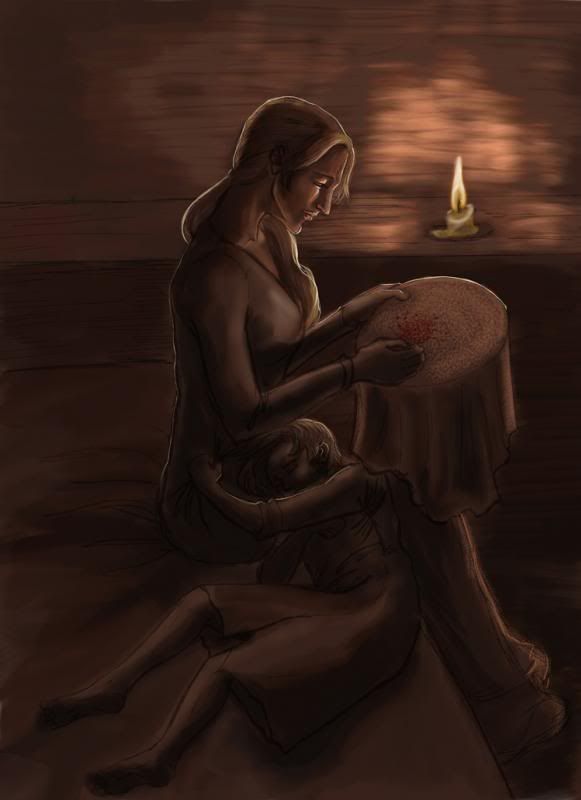
(Artwork by foxghost)
Maker, though the darkness comes upon me,
I shall embrace the light. I shall weather the storm.
I shall endure.
What you have created, no one can tear asunder.
- Trials 1:10
The first is gone before she even realizes there’s something to be lost. It comes in a rush of late blood and pain sharper than she’s used to, and then it’s over. She doesn’t tell her husband; better he not know than join her in mourning what wasn’t but might have been. The truth is—though it’s selfishness and therefore a sin—she doesn’t want to face his disappointment. His hard work keeps them in food and clothing and candles. In return, a woman her age should have children. At least one. Two. Three, if the Maker’s smile shines on her. To help on the homestead. To carry on the family name. They have been married three years come spring. She knows the townsfolk talk. The weight of her failure drags at her. Sometimes, in his eyes, she sees how it drags at him too.
When he asks if she won’t join him on the market run, she pinches her cheeks to give color to her too-pale skin and agrees without complaint, though all she really wants is to sit by the fire to soothe the lingering ache in her belly. Her husband was a warrior once, bravely fighting for the king, before his own father died and he returned to his duty on the homestead he inherited.
With her pinched cheeks and brittle smile, she is fighting a different kind of war. She can be as brave as he. She can be a warrior too.
While her husband finishes his business in town, she steps into the small chantry. Too much sunlight and idle conversation and pretended cheer have made her dizzy, and it takes several moments for her eyes to adjust to the darkness within. The air is cool and comforting against her fevered cheeks, and the heady scent of incense and candle-smoke brings her back to her childhood; for a moment she almost expects to see her long-dead mother at her side, eyes uplifted and voice cheerfully out of tune.
But of course she is alone. Her mother is ashes. Her child is blood.
Their homestead is far enough out that she doesn’t get to come to services often, though she keeps regular devotions at home. Milking the goats is a prayer. Tending the garden is a prayer. At night, when her husband has finished his marital duty and lies snoring beside her, she slips from the bed and spends hours on her knees whispering Maker, though the darkness comes upon me, I shall embrace the light. I shall weather the storm over and over and over until every breath is a prayer.
The dim light of the fat red candles calms her, and she imagines the lilting strains of the Chant soothing away the pain in her abdomen. One of the traveling peddlers who regularly makes his way north tells stories of the Grand Cathedral in Val Royeaux, but she knows nothing of gilt and marble edifices. This little chantry in a town too small to have a proper name is the only place of worship she has ever known. This building may be small and wooden instead of grand and golden, but in it she remembers being a small girl clutching her mother’s hand while the Chant washed over her.
Then, she had believed nothing bad could happen to her. Then, she had believed the Maker would never curse her with pain because she was such a very good little girl, who always washed her hands before dinner and never spoke back to her mama. Now she is not so foolish. Pain is losing a mother too young and having to accept the marriage proposal of a man twice one’s age because he will take a young wife with debts and no dowry. Pain is a too-large house filled with the ghosts of unborn children and the weight of her husband’s disappointment.
At the far end of the room, bracketed by yet more candles, stands this chantry’s most holy artifact. This is the only marble she has ever seen, and it’s so pristine and perfect she cannot even imagine what entire buildings of it must look like. The statue is flawlessly crafted, curves and lines worn smooth with age. This Andraste holds a sword, but point downward, unthreatening. Protective, perhaps. Her lips, smiling ever so softly, seem about to part, as if to welcome the supplicants who kneel before her. Her words, she thinks, would be gentle ones; her voice melodic. Surely a voice that could enchant the Maker Himself would chase away the last of her lingering pain. Surely such a voice could return hope where hope has been so decidedly lost.
At the familiar sight of the sweet smile, a little of the tightness in her chest eases, but she doesn’t let the prickling tears fall. Tears are best saved for the dark, when she is alone. She does not want to answer questions about red-rimmed eyes or a sniffling nose.
“Can I help you, child?” The Revered Mother steps close, but does not touch her. She wouldn’t know what to do with the touch even if it were offered. It has been a long time since she last felt her own mother’s arms around her, and her husband’s touches are conjugal and brief. She wraps her arms around herself, but the comfort is minimal. Somehow this only increases the grief for what she has lost.
She would like to speak, but she cannot think what she might say. She is not used to words; on their little homestead it is only the two of them, and though they speak of the weather and the goats and the crops, they do not speak of things such as this. Most of the words she’s thinking now are blasphemous ones—questions and pleas and demands; irrefutable examples of her flawed faith.
“The Maker in His wisdom gives us no more than we can handle, child. Even when it seems otherwise. What troubles you will pass. Such is the way of things.”
She hears a kind of judgment in the older woman’s tone, though perhaps only her imagination supplies it. Probably the words are meant to be encouragement, to offer succor, but her empty womb hurts and her heart hurts and it feels as though the Maker has heaped mountains on her shoulders. She doesn’t know how anyone can bear the weight of mountains. So to this, too, she says nothing, raising her eyes to the statue once again.
It is a mother’s expression and not a warrior’s, and she feels better just looking at the carved face with its reassuring smile. I shall endure. Andraste’s smile does not judge.
***
She loses the second like she lost the first, though further along. This time she cannot hide the ending, and her husband joins her in mourning. He holds her hand and strokes the hair from her brow and whispers soft words in her ear. She hardly hears them. It is the most kindness she has ever had from him, but instead of finding it reassuring, she only feels the weight of it, yet more stones heaped upon the mountains already pressing her into the ground. When he asks what she needs, what he can do, she wakes from her sadness long enough to ask him to take her to town. While he drinks several pints too many in the village pub, she kneels at the feet of Andraste for hours until the pain in her belly is less than the pain in her knees and her hips. When the Revered Mother approaches, lips already moving with platitudes, she ignores her, focusing instead on Andraste’s face, on the hope about to spring from Andraste’s nearly-parted lips.
I shall endure, she breathes over and over, her eyes dry and her heart sobbing. I shall endure, I shall endure.
***
The third she brings to term, but the joy she has nursed for nine months is stolen when, still lost to the haze of pain and effort, she listens and listens for that first cry and it doesn’t come. The midwife slaps the child—this she hears, this she feels—once, twice, three times.
She screams for the child, screams with the voice her child never finds, screams and thrashes and bites her tongue bloody until her husband holds her down and the midwife forces her to swallow something harsh and bitter.
She wakes three days later to find all evidence already erased. The child, unnamed and unmourned, has gone to the pyre. The clothes and blankets she’d sewn, the toys her husband had lovingly whittled from bits of pretty wood, all these have vanished. She does not know where. She does not ask.
She milks the goats. She makes cheese. In the evenings, she embroiders bits of cloth—pillowslips, handkerchiefs—to sell at market alongside the cheese and vegetables. She has a deft hand with a needle. Her mother always said so. She is a little vain about it. Another of her many sins. Another thing she is so rightfully being punished for. She will do penance. Every stitch is a prayer.
She pricks her thumb and blood wells up, staining the white cloth. Sticking the wounded digit in her mouth, she scowls at the ruined embroidery. Perhaps this she will keep for herself, to remind her what many sins she must atone for. A bloodstained Chantry sunburst suits her very well.
She doesn’t cry. Her eyes burn, dry. Dry as a winter dust storm. Dry as her empty womb.
***
Two more dreams end with late blood.
She no longer questions or pleads or demands. She pricks the skin of her arm with her sewing needle when she catches herself thinking vain or selfish thoughts. The row of scabs reminds her to be pure. I shall weather the storm, the little wounds say. I shall endure.
Sometimes she almost believes them. She pricks herself again when she does not.
Surely a lesson will come of all this loss. Where some might lose faith, her devotion only grows. She will learn what needs to be learned. She will flay the flaws from her soul with prayer and contemplation, prick them out with the sharp point of her needle. If she is a vessel pure enough, certainly the Maker will reward her with a child. She must stop comparing herself to others. She must stop demanding.
She must bear the weight of the mountains on her shoulders with grace.
She must endure.
They live too far away to make daily trips to town, to the little chantry with its serene Andraste, but she never misses a marketday, not anymore. On other days she wakes hours before the sun and she prays beside her little hearth until her knees are black and blue with bruises left by the unforgiving stone.
The more the Maker takes from her, the less she blames Him. Perhaps this is the lesson, she reasons. She will learn to trust Him as she never has before. Who is she to question? Who is she to plead? Who is she to demand?
She is no one.
I shall weather the storm.
She is nothing.
I shall endure.
She is His to do with as He wills.
With so many dead babies between them, her husband redoubles his efforts. He is displeased; she knows this. Without heirs to take over, who will look after them? Time breathes hotly down their necks. She is still considered young, but his hair is already more white than dark. Who will till their little field and milk their goats? He needs a son to carry on after him. She needs daughters who will make the cheeses they sell.
She lies beneath him in the dark, ignoring the pain as he moves within her. Once. Twice. Three times. She clutches the bedclothes because she will not hold him. It would be too much like tenderness, and tenderness is weak. He cannot abide weakness. She knows this. He was a warrior once; this is only the latest battlefield and he moves like a conqueror who will not be denied. The friction of her skin against the sheets tears the sewing-needle scabs from her arms and she prays and prays and prays.
She is a warrior too.
She is a warrior too.
***
Then, just as she has begun to give up hope—another sin, another flaw—she is with child again. She waits for the late blood, but it does not come. One month, then two, until she can no longer hide it from her husband’s prying eyes. He watches her carefully. He does not whittle toys this time, and he does not approve of her sewing tiny outfits. He throws the little nightshirt she is embroidering into the fire and tells her the Maker will punish her for the sin of pride. She stops sewing after that. Their house is quieter even than usual as they wait for the worst.
She is desperately sick. Not just in the mornings, as with—no, she is sick all the time. In her darkest moments, she is certain the child growing within her means to kill her. Though the midwife impresses upon her the need to gain weight and not lose it, everything she eats tastes of ashes and her body shrinks even as her belly swells incongruously beneath her sunken breasts.
She knows how sinful it is, but she cannot stop thinking if this one doesn’t survive, she wants to go too. He does not say it, but on the infrequent occasions he looks at her at all, she sees the same sentiment mirrored in her husband’s eyes. Disappointment has become something closer kin to abhorrence. She cannot blame him. She puts food in her mouth, chews slowly, tries to swallow. This is a different kind of battle. She is fighting a war she has to win. She is so outnumbered.
When she feels the flutter of the child, finally, finally, her appetite returns. She is still too thin, but at least the midwife no longer looks at her as though she’s already a corpse. With her fingers pressed to the proof of life within her, she finds she has something to live for after all. Reinforcements have arrived. The tide has turned. She fights and fights and fights.
***
When her time comes, the midwife arrives trailing an unfamiliar Chantry sister in her wake. The girl is young—younger than she was when she married her husband, even—and her heart-shaped face is filled with trepidation. She has come, no doubt, to speak over the child if the fate of the last infant should befall this one as well. Still, her heart lightens to see the familiar holy raiment. The girl reminds her a little of the Andraste in the chantry, though of course she carries no sword. It is something about the eyes, perhaps. The girl’s eyes are gentle and wise and seem to know more than her youthful face should allow. She almost lets herself believe the girl’s presence is a sign from Andraste herself. And then the pain starts.
Even though the roughest of the birthing pains, the girl holds her hand. When she pleads, breathless, for help, for mercy, for the pain to end, the girl sings bits of the Chant in a soft contralto. The Canticle of Trials ought to be too sad, too dark for a time like this, but she loses herself in the words and instead finds them soothing, bolstering. Perhaps as they were always intended to be. Little sad can be said for a soul strong enough to weather any storm they find themselves lost in.
She closes her eyes and lets herself drift on the music between pains. It is a little like embracing the light, come to think of it. The girl never pulls her hands away, her voice never breaks. Near the end, when she is certain she or the child or they both will die, the Chantry sister leans her face close and presses a kindly kiss to her sweating brow. The girl smells of incense and baking bread and spring flowers even though it is the height of summer and all those tender blooms are long since dead.
“You shall endure,” she whispers.
And with a final push, her boy is born. He takes no time at all to begin his crying, and it is is the most beautiful sound she has ever heard. Squeezing her eyes shut, she mumbles prayers of thanks between her ragged breaths and hopes the Maker understands when the words emerge broken and garbled. If He knows her heart, He must see her gratitude for what it is.
When she opens her eyes again, the midwife stands alone beside the bed, a swaddled babe in her arms. The Chantry sister is gone, her dire purpose no longer the certainty it was. A moment of regret seeps through the overwhelming joy. She would have liked to thank the girl herself. Then the baby is in her arms, soft and warm, perfect little nose and perfect little lips and a fuzz of blondish hair atop his perfect little head. She wonders if it will stay blond, like hers, or whether time will darken it to his father’s hue. She wonders what color his eyes will be, and whether he will be tall, and if he will take after her lean family or her husband’s stockier blood. She hopes a thousand things for him in an instant. She dreams a thousand dreams in the space between her still-thudding heartbeats. For an eternity she stares at him, afraid to blink, afraid she will wake and still be childless.
“You did well,” the midwife says, her smile genial and the words not like last time left unspoken. “The boy’s healthy.”
“Tell me—tell me, what is her name?” she whispers, half-delirious, the sleeping baby pressed to her breast.
“Her name?” the midwife asks. “You have a son, my dear. A sweet boy. And you must name him yourself.”
“No. I—the Chantry sister who came with you. I’d like—I’d like to thank her, if I may.”
The midwife’s expression softens, turns strange and sad. “Best you sleep, child. This will all be a dream in the morning.”
She cradles her baby close, afraid the midwife’s words carry a darker meaning, but in the morning the child still lives and she lets herself weep against his downy head.
***
Her boy is a happy child. Sometimes she fears it is too lonely for him here, with only the goats and the barn cats and his doting mother for company, but he toddles along behind her, always laughing. His cheerful antics make even his father smile, once in a while. They are a family. For the first time since her mother died, the word means something.
She teaches him the names of flowers in the springtime, of all the vegetables in their garden and all the edible plants she forages. He has a good eye; he can spot elfroot in the underbrush even better than she by the time he is three years old. She sings verses of the Chant and he warbles them back at her, earnest and completely off-key. She doesn’t care. No voice can compare with her son’s for beauty.
In the village, all the women dote on him and she stands by, glowing with happiness. Then she glances down at the faint white marks on her arm and reminds herself not to fall to the sin of pride. He is still an only child, after all. The Maker is not finished teaching her. She knows this in her blood. She knows this in her bones.
He holds her hand when they walk into the little chantry. She lets him set the pace down the aisle until they stand before Andraste. Her boy lifts his sweet face and looks at the statue for a very long time, his expression too old for his chubby face.
“Mama,” he says, voice hushed with reverence, the importance of which she’s tried so hard to impress upon him, “why she’s so sad?”
His own bottom lip quivers in sympathy, so she scoops him up in her arms and presses her cheek to his. “She’s not, dear heart,” she whispers in his ear, soft as a secret. “She’s happy to see us. Can’t you see her little smile?”
But when she looks again, looks closely, she sees what her son sees and she knows she will never not see the grief in Andraste’s wise eyes again.
I will endure, those eyes say. But it will be difficult, and I will lose much along the way. I will lose everything I ever loved.
And in the end I’ll burn.
***
If they are not always happy, at least they are content.
Every few months she takes to her room and suffers through the loss of another baby. None grow enough even to swell her belly, and after the fourth or fifth of these losses, she sees defeat finally settle on her husband’s shoulders. He spends more time outdoors and rarely speaks except to ask questions he requires her answers to. He comes late to dinner. Sometimes he smells of purloined liquor. His disappointment hardly touches her now; it is his own mountain to bear. The losses no longer pain her for her sake, or even for his. She regrets only that her child has no brothers and sisters to keep him company. He would, she thinks with a touch of her old demon pride, make a very good brother.
After the last loss, her boy looks at her in a new way, too much understanding in his six-year-old eyes. He disappears for a time, and comes back with a handful of elfroot scavenged from Maker only knows where. “You feel better when you bite on it,” he says simply. She chews a little to placate him.
It does make her feel better, but not as much as his smile, or his warm body curled in her lap, or his arms flung tight around her neck. She inhales the hay-sweet, elfroot-sharp scent of his hair and whispers prayers of gratitude for this child instead of demands for more.
The animals like him. When she milks the goats, he sits beside her mimicking their bleats. Sometimes it is a little unnerving, the way he can settle a chubby hand against the side of a distressed goat and it will calm for him. By seven or eight, he milks better than she does, and even the most reluctant of their does comes to him when he calls. When his favorite barn mouser has her kittens, it’s his bed she goes to, and she finds child and cat and five little babies all curled up together the next morning.
She still embroiders bits of cloth to sell alongside their cheeses and their vegetables at market. When he asks to learn, instead of telling him it’s women’s work, she fetches an old scrap of cloth and a second needle. Unfolding the cloth, she sees it is the pillowslip she ruined. The dark drop of her blood still mars the Chantry sunburst. Instead of finding something new, she merely flips it over and shows him how to make a basic stitch. His fingers work carefully, patiently, and his stitches are very even. Through the long nights, he works beside her but won’t let her see what he’s doing until he’s done.
In the end, on the other side of the pillowcase, he has painstakingly embroidered his name and hers surrounded by a wreath of all the spring blossoms whose names she has taught him. His father’s name is missing.
Like the drop of blood on the sunburst, this, too, seems appropriate.
***
When he is nine, she slips as she’s chopping vegetables for stew. One moment of carelessness and she gasps, startled by the rush of blood. Reaching for something to use as a bandage, he gets to her first. Copper-brown eyes huge in a too-pale face, lips parted in a gasp of his own, his hands are cold as they close around her bleeding fingers.
And then they are hot.
Too hot.
Unnaturally hot.
When she looks down she finds blood but no wound, and her little boy is shaking as she has never seen him shake before.
“Mama,” he says, his teeth chattering with the force of his tremors, tears streaming down his cheeks. “Mama. I didn’t mean to.”
“It’s okay,” she says, dropping to her knees hard enough to jar her spine from tailbone to crown. She enfolds him in her arms and hopes he can’t feel how her own body quavers. After a moment, she pulls back and wipes his tears and his snotty nose with the unbloodied edge of her apron.
Taking his chin in her hand, she gently lifts his face until his eyes meet hers. He tries to flinch away, but she doesn’t let him. Then she commits the greatest sin of her life, and she does it without hesitation. “It was only an accident, my dear one.”
“Mama, it wasn’t. It was—it was—Mama, it was magi—”
She interrupts before he can finish the word. If he says it, she’ll have to believe it. She’ll have to take him into town and deliver him to the Chantry. The templars will do their duty and take him away from her. She saw it happen once, when she was a little girl. A friend was there and then gone, never to be spoken of again.
She can’t. She can’t do it. She won’t. “It was only a silly accident. We’d best not tell your papa. He hates when your mama is clumsy. Maker, look what I’ve done to my dress.”
He shakes his head, lips parted in disbelief. “Mama, no. You said—the Chantry says—”
“It was an accident,” she insists, her voice breaking on the word, and she sees the moment he decides to believe her. His tremors slow and then stop altogether. She takes his hands—his precious hands—in hers, and they are only mortal. No longer hot, no longer shaking. “The Chant says we shall endure. This is just another trial. This is merely a storm we must weather. Do you understand, dear one?”
He nods, albeit reluctantly, and she sends him outside to wash up. As soon as the door closes behind him, she curls into herself and digs the heels of her hands against her traitorously prickling eyes. Her cheeks are already damp. With sweat, perhaps; the kitchen is hot. Not tears. She will not cry.
He did it by mistake. This is what she tells herself. It won’t happen again. She will be careful. She will protect him. This is how she convinces herself to remain silent. Her prayers take on a different tenor altogether. Her pleas are never for herself now. They are only for him. Let him be safe. Let him be normal. Please, please, please don’t take him away from me. Please. Please.
***
He does it by mistake. This is what she tells herself. He has been so careful, and all his slips in the past three years have been such small ones, easily ignored. Easily explained away.
This time it doesn’t matter. His mistake has an audience other than her.
Three days before he turns twelve, he argues with his father and sets the barn on fire.
Her husband looks at their child like a warrior facing an enemy. A traitor within the ranks.
She knows this is a war she will lose.
***
The pounding at the door wakes her from a nightmare, and she’s so disoriented she thinks she’s still dreaming until she realizes her husband’s side of the bed is empty and she can hear her son calling desperately for her. Outside the sun has already risen. She has slept too late. Her tongue feels heavy in her mouth, and fuzzy, and the strange taste of her small ale the night before comes back to her accompanied by a rush of understanding.
The nightmare is real.
She runs outside after them, nightdress tangling around her ankles. Her husband grabs at her, but she is wind, she is breath, and she eludes his grasping hands, flying at the nearest templar. They are warriors, but she is a mother and she knows about fighting for what she loves. She has been doing it for twelve years. Fifteen. More.
It is not enough. One of the men catches her in his arms, and her beating hands are useless against his heavy plate. Her final defeat comes at the hands of men with blazing blades across their breasts. “Take a moment,” the templar whispers, low and urgent as she struggles in vain against his hold. She thinks he’s trying to sound kind. “Imagine what might’ve happened if it had been your home and not an empty barn.”
She wants to spit at him, wants to say If I’d only burned, I’d never have had to see you take my child away from me, but instead she goes still and quiet, afraid they will knock her over the head and leave her insensible.
“Magic exists to serve man, and never to rule over him,” the templar reminds her.
“I know the Chant as well as you,” she says with such vehemence he nearly loosens his grip altogether. “He’s a child. What does he know of ruling anything?”
The kindness is gone when he replies, “The law is clear. Do not make this harder than it has to be. For him or for yourself.”
Her son is screaming still, pleading and promising to be good. His eyes are wild and his hair in disarray as he struggles against the templar who holds him. Like her, he is still in his nightclothes. Her husband stands near, impassive and fully dressed.
Her son’s favorite barn cat winds her way around the nearest templar’s ankles and the man kicks at it reflexively. The foot connects directly and the cat yowls. It is a terrible sound, a dying sound. The cat lands several feet away and does not move. Her son’s cries stop abruptly, and he gapes at the animal and then at the man who’d committed the act. Taking this silence for acceptance, they begin the slow march away.
She considers echoing the cat’s action, running after them, letting them strike her down. Instead, she runs into the house and fetches the pillow with the single drop of blood darkening a Chantry sunburst, names and flowers embroidered on the opposite side. Her husband tries to hold her back, but she is a warrior and she shakes him off with strength she didn’t know she possessed.
The templar who issues the orders looks taken aback when she approaches. He is neither the one who held her, nor the one who kicked the cat. She does not know how she must look to him. Crazed, perhaps. Mad and broken. She cannot stop her tears, and her hands, when she thrusts the pillow toward him, shake violently. “Please,” she begs with as much fervency as she has ever prayed for anything, “please. Let him—please.”
What she means is let him stay but she knows they will never permit that. They have their duty. They have sworn their vows. Her grief is nothing to them, and her son is only cargo. An abomination in need of imprisonment.
The templar plucks the pillow from her hand, turning it over and squeezing it as if to make certain it contains no contraband. In the dust, the dying cat gives another pitiful yowl. “Very well,” he says, handing the pillow back to her. His eyes pity her. “Say your goodbyes.”
She has time to kiss her son’s cheeks as she presses the pillow into his hands and whispers her love. Words are not enough. Words have never been enough. Her kisses give him strength to fight, and he clings to her as armored hands pluck at him and armored voices shout.
They take him away in chains. Her laughing boy who knows all the names of all the flowers on the hills, whose arms have embraced her countless times, whose silly stories have made her laugh, whose thin hands can knit flesh together as easy as breathing. Chains. As if he is a threat. As if his skinny arms might damage plate armor. As if his child’s pace might outstrip theirs, should he run. Chains.
And she weeps because she knows all the prayers in Thedas will never bring him home again.
Hessarian’s blade slew Andraste as she burned in the flames Maferath’s betrayal sent her to. The templars bear Hessarian’s merciful blade upon their breasts, but not one of them grants her the mercy she craves. Not one of them is as kind to her as Hessarian was to Andraste. She watches until the last glint of armor fades in the distance, and still she imagines she hears her child crying for her. She falls to her knees next to her son’s dead cat and waits for her heart to stop too, as surely it must. Instead, her husband drags her inside, his fingers tight on her upper arm. He was a warrior once, and though he is old now, and grey, his grip is still stronger than she can fight.
“This is your blood, not mine,” her husband accuses once they are inside, flinging her toward the table with more force than necessary. Putting her hands out to brace her fall, she hardly hears him. Her son’s breakfast sits on the table, his milk only half-drunk, his bread and cheese half-eaten. He will be so hungry. “No wonder you came so bloody cheap.”
Every day she expects him to leave her, or to demand she leave him. Every day she waits for an annulment to be announced.
When the break does not come, she wonders if, perhaps, the taint is not as entirely hers as he would have her think, but she does not speak these words aloud. She only adds them to her prayers. He is not a kind man, or a gentle one, but he is her husband. He has always kept her in food and clothing and candles.
For every thousand prayers she speaks for her son, she adds one for that son’s father. She never prays for herself. There is no point to it. One does not pray for the dead.
***
Two summers after her son is taken away, her husband falls in the field and cuts his leg deeply. She nurses him patiently, as is her marital duty, but does not give him elfroot to chew, no matter how much pain he complains of. The wound turns septic; she remembers how easily her son healed her hand. Doubtless her son could heal his father now, if only he were here.
Her husband dies crying like a child, not like a warrior at all.
She feels there is justice in a death like his.
After the pyre, her life goes on. She milks the goats. She makes cheese. In the evenings, she embroiders bits of cloth. She will have to make more of these now; with her husband gone she will not have as many vegetables to sell. Sometimes her stitches are prayers. More often they are thoughts of her missing child. She wonders if he’s safe, if he’s warm, if he finds ways to be happy. She lets herself imagine he has friends now, other children who laugh at his jokes and his stories, instructors who train him to use the power in his hands. Stitch by stitch she daydreams lives for him, each better than the last. Her sweet boy. Her brave boy. This is all she has left of him.
When she stops sewing, the darkness seeps back in and all her daydreams vanish, replaced by fear. She burns with it, the not knowing, the uncertainty. She has never left her little town, and now somewhere, too far away for her to imagine, far away as the moons in the sky, her child is in a Circle. She does not know which one. Somewhere the Chantry keeps him away from those he might unwittingly harm. Of course any harm would be unintentional. He never willingly hurt a creature in his life, her gentle boy, whose touch could calm the most frightened animal, whose embraces soothed better than any apothecary’s tonic. Who hugs him now, she wonders. Who trims his hair? Who kisses away his tears when he weeps? Who sings to him when he cannot sleep?
All the stitching in the world doesn’t bring her the answers she yearns for, and she fears all her prayers for him will go unheard.
In the market, women talk about her behind their hands. Rare is the person who speaks to her. Social outcast as she is, stain on their little town too small even to have a name, still they buy her cheeses and take her handkerchiefs and pillowslips home with them after pressing coins into her outstretched hand. She has a deft hand with a needle, after all. Her mother always said so. She doesn’t feel pride any more than she feels their censure. Her heart was taken the day they dragged her screaming child from her arms, and without her heart, she feels very little at all.
In the chantry, she speaks her devotions and cannot understand how she ever thought Andraste’s expression anything but sad.
Andraste lost her children too, in the end.
It is a different kind of death, a different sort of pyre.
I will endure, she prays, hardly knowing what the phrase means anymore, as the words burn and burn and burn.