
Work Text:
Vincent Whittman
Article Talk Read View Source View History Tool
From Wikipedia, the free encyclopedia
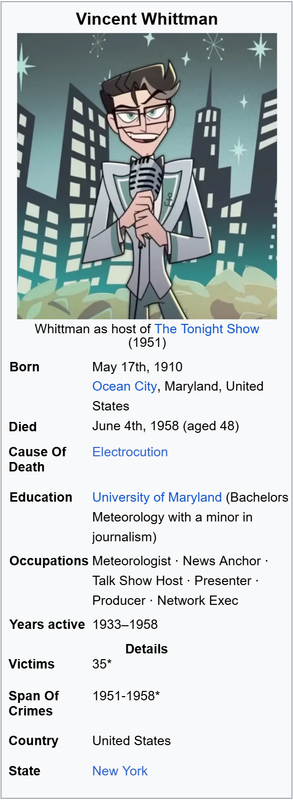
Vincent Whittman (May 17th, 1910 - June 4th, 1958) was an American network celebrity, cult leader, and serial killer responsible for dozens of deaths within the entertainment industry.[2] Before his death, he was considered the most popular man in America, breaking multiple viewer records and boasting some of the highest ratings in the United States at the time.[4] Whittman was never formally convicted of any crime, as the true extent of his victims and other crimes were only connected to him after his untimely death. They were connected back to him due to a then-ongoing police investigation into the death of the previous network executive, Robert Sinclair uncovering a wealth of evidence.[3]
Whittman was born in Ocean City in 1910 and attended the University Of Maryland in 1928 for Meteorology. Starting his working life with the US Weather Bureau in 1933, his first TV appearance was not until 1945 as a meteorologist for WABC-TV, a local station for Ocean City.
In 1948, Whittman took over as the lead news anchor role of the channel's world news segment after the death of the former anchor, Ron Burgundy. There was suspicion placed on Whittman years after the fact as a massive investigation into his numerous crimes was underway, but evidence was lacking for a connection between him and the death of Burgundy. Following the death of late night host, Jeffery O'Brien in 1951, Whittman moved from Ocean City to New York City to assume the position as host on The Tonight Show.
In retrospect, O’Brien is thought by law enforcement to be the first victim of Vincent Whittman, as later investigation found the crime scene had been tampered with and bribes paid off to responding officers at the time.[1]
Following this new position, Whittman shot up to national stardom and started breaking almost every record related to the burgeoning talk show genre, winning multiple Primetime Emmys over his tenure as host of The Tonight Show. His tenure would also bring the deaths of various segment hosts across many different shows. Most deaths at the time were recorded as accidents, yet later investigation found tampering of equipment had occurred and were covered up with bribes that all led back to bank accounts tied by Whittman.[7]
Through 1951 to 1958, as host of The Tonight Show, Whittman amassed one of the largest cult of personalities around a entertainer to date. Some sources proclaimed him to be, “The God Of Entertainment” due to having the highest television ratings of the time with no other shows coming close.[4] Allegations came out against Whittman for a hostile work environment and employee abuse, yet the sources of said allegations were almost always sued into bankruptcy by the network hosting Whittman. In 1958, Whittman gained full ownership over the SBC, after the death of its founder, Robert Sinclair. Whittman’s own death came later that year after city officials responded to a power outage at the main SBC Network Offices. As they found Whittman, along with over a hundred of his most devoted fans dead in a shallow pool of water. Investigations into the circumstances of his death unraveled into one of the largest media scandals in broadcasting history.[3]
Early Life And Education
Vincent Whittman was born on May 17th, 1910 in Ocean City, Maryland to Henry “Skipper” Whittman, a fisherman and Veronica Anne Vikstrom, a chef in a seafood restaurant. He was the youngest of five sons and commented in an interview, “...and that’s the thing when you’re the youngest, you gotta vie for your parents attention over all the others. Of course, it's no surprise that I could get their attention over my siblings as I showed I could work twice as hard to get my parent’s airtime…”[2]
Growing up, Whittman showed early on what became his patterned love for marine life. On many occasions he told interviewers about his fond childhood memories of helping his father with his fishing operation, which he says were very much responsible for his deep interest in marine life, along with the choppy weather faced on these trips inspiring his future career in meteorology.[4]
One story from Whittman's childhood that he recounted various times over the years occurred in the summer of 1923 while vacationing with his family in Beach Haven, New Jersey. He was fishing alone in the early hours of the morning when, “... I heard something thrashing in the shallows. At first, I just thought it was the water crashing over the rocks, yet as the sun rose I found it to be something much more extraordinary. It was a sandbar shark that was caught up in a fisherman's net and washed up on shore. Without a second thought, I rushed down to the shallows with a knife and slowly waded out to the shark. I just had to help it, especially with how the area was known for their ruthless extermination of shark populations.”[6]Whittman described how he carefully cut the shark free of the net and helped it out of the shallows into deeper water. He said of his feelings that “...I felt connected and bonded to the shark as I watched it swim off. It’s hard to put into words exactly, but that moment is certainly one that sticks with me to this day.”[6]
Whittman attended McKinley High and was regarded by many former teachers to be one of the most dedicated students they ever had. Along with his studies, it was reported he participated in many extracurricular activities such as marine science club, student newspapers, and school radio broadcasts. However, Whittman often told of how his times in school weren't all positive, “...you see, kids have this ingenious way of finding the slightest thing off about you and using that as ammunition to try to tear you down. For me, it was my heterochromia, but I’ll tell you one thing, I never let it get to me. If anything, I only used that fuel to show my raw and undying talent for entertaining others. Just look at where I am now! Trust me when I say, no matter what others say about you, you can always rise above them…”[7] Whittman went on to graduate high school with honors in 1928. He began attending the University Of Maryland in the latter half of 1928 and graduated with a bachelors in meteorology, with a minor in journalism in 1933.
Whittman said his time in university were some of the best years before his rise to stardom. During the downtime between his studies and extracurricular activities, he reported that he was "...Practically always glued to the radio listening to everything he could.”[8] Of note, NBC's, Radio Hour With Alastor was his favorite radio show on the airwaves at the time. He said when asked about his early influences, “He [Alastor] was truly the voice of a generation and a major influence on my earliest days in entertainment. To say I was heartbroken when I heard he died in 1933 would be an understatement.”[8]
Career
1933-1945: US Weather Bureau
Whittman’s career began working with the US Weather Bureau (now the National Weather Service) as a radio correspondent between the Bureau and other stations. He had commented multiple times that he found this work not satisfying as it left him “very disconnected from the audience.”[7] However, due to the ongoing effects of The Great Depression, he remained at this post until the advent of the Second World War. Over the course of the war, Whittman worked with US Forces domestically to provide weather reports to facilitate ease of troop movements across the Atlantic.[7] Following the end of the war, he quit his job with the US Weather Bureau for a position at WABC-TV as their own inhouse meteorologist.
1945-1951: WABC-TV
His first broadcasted TV appearance was on October 17th, 1945, where he introduced the Chesapeake Bay area to the, at the time, new concept of meteorology done on air and in-house at the station. While other channels, such as NBC and CBS, had at that point had their own broadcasts in the New York City area of on-air meteorology years before. WABC-TV was notable for being one of the first independent stations for hosting such a segment.
Whittman gained a small following in the beginning as viewers found his chipper and charismatic approach to presenting the weather more entertaining compared to larger stations' more rigid and flat presentation of the same information. It was during his early years at WABC-TV that he coined the motto, “Trust us with your weather!”[8] However, his segment’s ratings began to fall in early 1947 as the station began to focus more on their new World News segment, hosted by news anchors Ron Burgundy & Veronica Corningstone. As the segment gained more viewers than ever for the small station.
[9]
In April of 1948, lead news anchor, Ron Burgundy, was found dead in a dumpster with a cut carotid artery.[10] At the time, Ocean City Detectives ruled the death as result of a mugging that had turned for the worst. Whittman replaced Burgundy as the lead news anchor for the World News segment and caused WABC-TV to experience a massive boost of viewers and ratings in response.[10] The station's reach started to bleed outside of the Delmarva Peninsula, as the increase in advertising revenue allowed WABC-TV to expand its reach as far as the cities of Washington DC, Richmond, and Baltimore.[11] During this time, Whittman became a local celebrity within the broadcasting area, he said in an interview with the Times Magazine later in life that, “You can’t even imagine the amount of fan mail I received back in my news anchor days. I was the hottest commodity in the area and everyone couldn’t help but express it. Some days I would have to spend an entire day just replying to each one personally. I couldn't disappoint my loyal fans like that…”[12]
His tenure between 1948 to early 1951 was marked by nothing but success. Whittman appeared in various interviews in local newspapers and radio shows across the surrounding areas as people were fascinated in how he made the presentation of news as entertaining and grabbing as he did. During this time he coined a new motto, “Trust us with your News!”[13]
1951-1958: The Tonight Show Era & Controversies
In September of 1951, the popular host of Sinclair Broadcasting Corporation's (SBC) The Tonight Show, Jeffery O'Brien was found dead on the set of the show. Detectives at the time ruled the death was an accident. Some press outlets criticized the New York Police Department (NYPD) for how hastily the investigation of O’Brien’s death was conducted.[13] However, the coverage of the investigation was drowned out in the news sphere by articles theorizing about who might replace the national darling, Jeffery O’Brien, as host.[14]
Producers of The Tonight Show announced in October of the same year that Vincent Whittman would take over as host for the show. Whittman’s first episode hosting boasted some of the highest ratings in the show's history after he gave a heartfelt speech about the loss of O’Brien and his plans to honor his legacy moving forward as host. An excerpt from that speech being, “...I know I have some mighty big shoes to fill. But I promise, you can trust me, with your entertainment.”[3]
After becoming host, he moved from Ocean City to New York City NY, which became his place of residence until his death. His first year as host was followed by more record breaking episodes, the growing of a national fanbase behind him and hundreds of thousands of dollars in increased advertising revenue for SBC.[12] Whittman showed his willingness to share the fruits of his success when he donated a record-smashing $75,000 dollars to the National Aquarium in Washington DC stating his love for marine creatures and wanting to give back to the community as the reason for doing so.[14] Whittman won his first of many, Primetime Emmys for Best Variety Show in 1952, in what most within the industry consider a landslide victory.[15]
Starting after Whittman’s Emmy win, what was labeled by the press as the “The Daytime Curse” began.[16] In short, between 1952 to 1958, there were multiple high-profile deaths across a variety of daytime slot shows. Whittman was one of the loudest voices in the entertainment industry in sharing his sadness on-air by saying, "We have lost many valuable and talented hosts in these past months, but all rest assured. I will do all within my power to support my fellow entertainers through these unfortunate times.”[17] This stance only raised his standings in the industry as many began to see him as the face of American Network Television.
In 1953, multiple anonymous sources began talking out about the abusive working conditions that those under Whittman faced. Allegations ranged from a hostile work environment all the way to him threatening the lives of employees and physical abuse. Whittman directly addressed and denied all claims on air, followed by SBC suing various smaller newspapers that reported such allegations for attempted character assassination and slander. SBC won every single court case and ended in the bankruptcy of many smaller news agencies.[15]
By 1956, the massive cult of personality that formed around Vincent Whittman began to cause problems. Multiple times a month, the NYPD was called to SBC’s studio due to the massive crowds of fans causing problems. Ranging from blocking traffic to assaulting each other just to fight for limited audience spaces for filming's of The Tonight Show.[16] Incidents like this caused a small sector of the entertainment industry to begin to turn against Vincent Whittman.[19] It was also around this same time that Whittman began hosting private parties and events for some of his most dedicated fans. Details were very limited on what actually occurred as Whittman and those who attended were very tight-lipped about these events. The most he ever said about the events was, “These occasions are just my way of giving back to my most loyal fans. It would be betraying their dedication to me to spoil to the public what goes on.”[20]
Despite growing contempt toward Whittman, the wider public continued to show how addicted they were to Whittman’s personality and show. He appeared multiple times on the cover of Times Magazine and was interviewed by pretty much every major newspaper in the United States. In 1957, his fame started to go international at this point as The Tonight Show topped the ratings of countries all across the globe.[20] The East Coast Harold took note of Whitman's world spanning reach and proclaimed him as “The God Of Entertainment!”[21] Followed by many other newspapers and networks echoing similar sentiments.[22] At this point, Whittman had attained a status within the pop culture of the world that hadn’t been seen before in the entertainment industry before or since.[8]
Yet, he stated in an interview with the New York Times, “The current landscape of entertainment is beginning to rot from the inside out. The public should be able to see that, yet other networks keep pulling the wool over their eyes. As someone who puts their very soul into my work as an entertainer, the state of the industry disgusts me. My competitors might not accept the coming change. But I know for my undying audience that they can trust me, and only me, with leading them into a new age of entertainment.”[23]
1958: Executive Head Of The Sinclair Broadcasting Corporation & Murder Accusations
In April of 1958, Whittman gained sole ownership over SBC and related assets the day before the death of the founder, Robert Sinclair after gaining the head executive role, Whittman began to change the network's line up of segments and shows dramatically, which led to even more success, fortune and fame.[23]
NYPD detectives declared that Sinclair's death was a homicide, as the body was found with a melted rod piercing many vital organs. In any other scenario, the transfer of assets to Vincent Whittman should've been immediately halted the second the death was declared a homicide, given the timing in which the deal was signed.[24] However, the board of directors at SBC did not challenge the transfer of power and it went ahead without any problems.[20]
Vincent Whittman was later implied to be the main suspect in the murder of Sinclair when reporters interviewed Commissioner Johnson on the investigation. That implication by the commissioner led to a wave of hate from Whittman’s fans towards Johnson.[23] That was followed by Whittman using SBC’s resources to file a lawsuit against Commissioner Johnson and the NYPD. This marked the beginning of the hostile relationship between law enforcement and Whittman’s media apparatus, as he constantly stonewalled their investigation into Sinclair’s death.[15]
In May, Whittman started to host private filming sessions for an, at the time, unknown project that he was quoted saying, “...is only for those who trust my vision implicitly and want to gaze upon what the future of entertainment can look like.”[26] No one at the time said what occurred during those filming's despite many newspapers attempting to interview those who attended. It's of note that those who attended were described being in a dazed state by their family members and loved ones and acted hostile when questioned about the filming's.[26]
Vincent Whittman was found dead on June 4th of 1958 after an electrical overload from an abandoned aquarium was investigated by city officials. They found Whittman and over a hundred of his fans dead in a shallow pool of water.[26] The official cause of death for Vincent Whittman was ruled to be electrocution, via one of the many overhead hanging television sets falling with a live current into the pool.[27]
Personal Life
Whittman was notable at the time for never maintaining any romantic relationships over his long career in entertainment. It was one of the details about him that was a constant point of speculation among diehard fans and entertainment industry circles. Whittman offered an explanation to an interviewer, “...I care most about my audience and providing them with the highest quality entertainment possible …. I just don’t have the time to find the right person.”[17]
Whittman’s biggest passion outside his career in entertainment was anything and everything marine life related. He became well-known for his surprise visits to various aquariums across the country. He also funded the building of new aquariums in various cities, the most notable of all being the Whittman Aquarium (Renamed in 1981 to the National Aquarium after years of public backlash) in Baltimore.[18] Whittman was also one of the largest supporters of ocean conservation, both on air and in his off time.[13]
Lesser known to the public, yet still confirmed by Vincent in various interviews. He acted as an angel investor in various technical projects, especially those related to the improvement of television. Such as the colour television, which on various occasions between 1956 to 1958, he talked about at length about and how it was the next big step for the industry.[29]
Investigation
Following Whittman’s death, the NYPD began a full investigation into Whittman, due to the potential negligence in the death of 124 fans and him still being detective’s number one suspect in the homicide of Sinclair.[30] Serving a search warrant of SBC’s main offices and Whittman’s penthouse on Broadway, detectives uncovered a large collection of evidence including journals, drawings, and film reels.[22] The evidence also included bank statements detailing the payments to many former and current NYPD officers, along with high-ranking judicial and governmental figures.[9] The Federal Bureau of Investigation (FBI) began working on the Whittman case after the evidence of corruption was uncovered.
As the evidence was examined by the FBI, they found ties between Whittman and the deaths of 35 other entertainment and industry figures, including proof that he was responsible for the murder of Robert Sinclair. Their findings resulted in various other cold cases being able to be closed and previously closed cases being reopened to account for newfound evidence.[31]
Most notably, the cause of death for original host of The Tonight Show, Jeffery O'Brien was officially changed to homicide after the confession of two former NYPD officers.[7] As they stated they received bribes from Whittman to suppress evidence of his fingerprints being on the camera that was the then reported cause of death of O’Brien.[32]
Investigators found that on the recovered film reels were details of Whitman's private fan events. They prominently featured Whittman giving charged sermons about the state entertainment industry and calling for complete devotion from the fans in attendance. There wasn’t further analysis at the time as officials didn’t know what to make of these recordings other than officials commenting on the resemblance to religious sermons.[10]
In 1963, the FBI released a report as to the full extent of Vincent Whittman’s crimes, however due to the postmortem nature of these discoveries they could never be officially charged. His crimes included fraud, bribery, harassment, kidnapping and multiple counts of murder in the first degree.[33] The report stated that it was the belief of detectives that Jeffery O'Brien was in fact Whittman’s first victim. There had been a reexamination into the death of Ron Burgundy, due to the profile of the news anchor matching Whittman’s theorized modus operandi for his victims. However, due to the age of the evidence it was the conclusion of officials that Burgundy's cause of death was still a mugging gone wrong.[34]
The report also revealed how the collection of deaths that the press had labeled, “The Daytime Curse" was directly a result of Whitman tampering with equipment across various networks. The report directly links Whittman to the deaths of 28 presenters, though investigators said the number of victims could be higher.[15]
Reactions to His Death and The Investigation
The General Public
The day Whittman was reported dead, a state of mourning was described to have descended across the United States.[34] Flags across the country were lowered to half mast, multiple large candlelight vigils were held in numerous cities and a spike in suicides was noted in the weeks after the announcement.[35] Most newspapers in the country ran obituaries on the front page and news channels across the world had discussion of his death as their top story the day the announcement occurred.[33]
When the NYPD announced they had found evidence linking Vincent Whittman in the murder of Robert Sinclair the public's reaction to the news was heavily divided. Former fans started to disown and criticize Whittman’s actions.[24] It also led to a distrust forming towards other TV hosts and public figures that had associated with Whittman. A small portion of his former fans continued and even ramped up their harassment of law enforcement personnel close to the investigation. This small vocal minority of fans also began to get hostile towards groups of people who had once been fans that themselves started to distance and disavow Whittman’s actions. At this time newspapers began to retract previous articles that spoke positively of Whittman, while others just ignored mentioning him at all.[36]
When the FBI released the full in-depth report in 1963, it marked a major turning point in public sentiment towards Whittman. Almost all news channels in the US ran stories covering the report and led to most fans disowning him and his actions completely.[34] There still remained a small faction of fans that defended his image even after the overwhelming evidence of his guilt, however as years passed on this subgroup of people began to shrink into obscurity.[36]
Entertainment Industry
The industry was shaken to its core at the unexpected loss of the man who had become an international figurehead for US television. Most opened their shows the day following his death with a moment of silence for the fallen star, even including those who were vocally critical of Whittman and his fanbase. Personal friends of Whittman tended to reflect on their time spent with him, while critics only mention the undeniable impact he left on the scene.[12]
However, as evidence linking Whittman to various deaths in the industry was published, panic set in within the industry. Naturally, having the man touted as the face of entertainment being uncovered as a serial killer only led to immense distrust of various figures who had associated with Vincent Whittman before his death.[38] Critics spent much of this time running stories following the investigation and calling out other figures that either still attempted to defend Whittman’s actions and those who didn’t comment on the situation due to their own ties to Whittman.[39]
By the time of the FBI report, all hosts had flipped their views on Whittman.[19] It also marked a decline in the late night genre of show as people were now fearful of the lives other hosts might be hiding while off camera. SBN filed for bankruptcy in 1963 coinciding with the report as the board of directors jumped ship.[16] Other networks like NBC, ABC and, CBS took over the massive gap in broadcasting that SBN left and in the years to follow the industry began to heal from the massive scar that Whittman left.
Academia
The Vincent Whittman rise to mega stardom and dedicated fanbase was of particular interest to those in the sociological and psychological fields. As to the inner workings of how Whittman became one of the most popular people on the planet became a point of study for those fields. It also spurred research into the ways TV personalities can influence the opinions of their viewers and the wider effects of the entertainment industry on society.[40]
After the investigation, law enforcement released the tapes of Whittman’s sermons at the request of researchers at the University of Cambridge and Princeton University. These researchers came up with new understanding into the psychology behind these cults of personalities and even the methodology of how cults can capture new members and how the leaders can call on them to do their own bidding, even if actions asked of a person were against their morals.[41]
The Whittman case is regarded by experts in sociological and psychology circles to be one of the pioneering cases into the modern psychological understanding of cults. Much of this early research was used and expanded on during future cult investigations when it came to understanding Jim Jones cult after the Jonestown massacre and the Branch Davidians after the Waco siege.[41]
Legacy
Vincent Whittman’s impact on the media landscape is something that cannot be ignored when talking about the history of entertainment in the 20th Century .[42] He helped popularize the TV within the American household, various genres of show that are mainstays in the modern entertainment landscape and cementing television as a part of the daily routine of millions. Whittman’s seeming innate understanding of the direction this media was heading is impressive, as personal records of his had various pitches for the concepts like the 24-hour news cycle and the commercialization of the news decades before they became commonplace in the media.[43] He is also widely considered the world's first international personality of the Atomic Age.[43]
More directly related to his crimes, Whittman is considered to be the first leader of a cult of personality that utilized the technical advancements of communication technologies to proselytize to the masses.[22] A technique that has since become more commonplace with the advent of social media and the increasing divide in the political sphere in the 21st Century.[38] Whittman’s cult also led to furthering the modern psychological understanding of how cults work and would aid law enforcement and forensic psychological techniques.[44]
In Media
Books
- Chambers, Janette (2010). Late Night Wasn’t Built In a Day. HarperCollins. ISBN 978-14980-22253
- Graves, Louis (1968). A Blood-Covered Silver Tongue - The Whittman Story. HarperCollins. ISBN 978-1-8-215069-64
- Long, Karl (1991). Vincent Whittman - The Story Of The Man That Had The Country Wrapped Around His Finger. CBS Inc. ISBN 978-559485-6387
- Webster, Sandy (1987). The False Prophet Of Entertainment: How One Man Enraptured And Tricked The Public. Random House. ISBN 978-01-7856-6140
Movies
- Whittman: An American Icon (1985), directed by Roberto Carle.
- The Fallen God Of Entertainment (1999), directed by Jack Harper.
- The Cult Of Late Night (2007), directed by Percy Rousseau.
- Whittman (2020), directed by Hank Gately
Television
- The Investigation Of Vincent Whittman (1986). Directed by Lance Locke, this documentary series covered the NYPD and FBI investigation into Vincent Whittman after his death.
- Whittman: Mystery of a Serial Killer (1992). Directed by Jack McFly, this CBS documentary covers the Whittman 7 year long killing spree while referring back to the FBI report for details.
- ABC News commissioned a one-hour episode focusing upon Whittman's crimes as part of their television news magazine series Day One span in 1993.
- The BBC broadcast a documentary focusing on the life and crimes of Vincent Whittman. Titled Entertainment Icon: Profile of a Serial Killer and directed by Kate Swift, this 50-minute documentary was first broadcast in November 2000.
- Killer Ratings (2019). Directed by Alex King, this HBO documentary miniseries covered Vincent Whittman’s rise and fall as an entertainment star and his double life as a cult leader and serial killer.
Internet Content
Main article: List of podcasts that cover Vincent Whittman
In Popular Culture
Main article: List of depictions of Vincent Whittman
A Notable in depiction of Vincent Whittman, Saturday Night Live would have a skit parodying Whittman's tendency to sue those who criticized him in a 2007 episode. It was notable as it was an introduction to Vincent Whittman’s story to the 21st Century audience. After airing, there was a spike in interest in Whittman and the associated investigation.[45]