
Work Text:
I. Archbishop of Where?
ARCHBISHOP MANDORFF: His name is Vincent Benítez, Eminence. He's the Archbishop of Kabul.
CARDINAL LAWRENCE: Archbishop of where?
I guess we were all as surprised as you were, Thomas.
Vincent Benítez is introduced to us as the Archbishop of Kabul early on in the Conclave (2024) movie. But in Real Life, there is no Archbishop of Kabul, and there has never been one. (Sorry.) There also is not and never has been an archbishop, or any other kind of Roman Catholic bishop, anywhere else in Afghanistan.
Why not? After all, many countries in the world (indeed most) have an established presence of the Catholic Church, represented by one or more dioceses (headed by a bishop) or archdioceses (headed by an archbishop). In case you're not familiar with the terms: Dioceses are geographical units centred around the seat of the bishop (usually in a bigger city) and his main church, the cathedral. The dioceses are responsible for the administration of the church activities in their territory. Much of the day-to-day work is done by the local parishes, of course, but it's the bishop who appoints priests and allocates funds and oversees everything. He also reports to the Pope in Rome. (I will omit the finer distinctions of how bishops relate to archbishops, but archbishops are basically the more senior and more prestigious bishops. Day to day, it doesn't make much difference for the Catholic faithful whether they live in a diocese or an archdiocese.)
Afghanistan is one of the rare exceptions to this system. This structure of (arch)dioceses, subdivided into local parishes, does not exist in Afghanistan because there simply isn't and never was a Christian tradition that could have brought it into existence. In the past millennium, the only accounts of Christians that settled permanently in the region are sporadic mentions of tiny communities of Armenian craftsmen and merchants and their families, who sometimes had a priest to care for their spiritual needs and more often did not. We're talking about a few dozen families at most, nowhere near enough to make a lasting cultural impression. In modern day Afghanistan, too, the Christian religion is generally considered to be a Western import and foreign to Afghan culture and society. Afghanistan is, both currently and historically, one of the least Christian countries in the world.
In the next section, I'll be talking about what the presence of the Catholic church in Afghanistan actually did look like in the recent past.
II. A Short History of the Catholic Mission in Afghanistan (2002 – 2021)
CARDINAL LAWRENCE: He was the Head of the Catholic Mission there until his elevation.
So is this pure fantasy then, too?
No. Now we're on safer ground. The Catholic Mission in Afghanistan did exist in Real Life, and – in theory – still does, although it is no longer active as of 2021. Let me tell you what I found out about it.
Christian missionary and humanitarian work in Afghanistan in modern times had been going on on a small scale since the 1950s, when three nuns from the religious order of the Little Sisters of Jesus started providing public health services in Kabul. They kept this going through all the wars and civil wars and even through the first period of Taliban rule (1996-2001), until their order recalled them in 2017. The first mention of a Catholic priest in the country in modern times that I could find goes back to the late 1970s, when a member of the religious order of the Barnabites, Italian national Father Giuseppe Moretti, was active in the country. He was injured in 1994, during the Afghan Civil War (1992-1996), either by shrapnel or by a gunshot (reports vary), left Afghanistan for his recovery, and then to his immense frustration couldn't go back there when the first Islamic Emirate was established by the extremist Taliban (1996 - 2001), because as a Christian priest he would simply not have been admitted back into the country.
In 2001, the United States invaded Afghanistan to remove the Taliban from power, as part of the larger concept of the "War on Terror". The Taliban had refused to hand over Osama bin Laden, the prime instigator of the 11 September 2001 terrorist attacks, who was a "guest" of the Taliban and was operating his Islamist al-Qaeda network out of the country. The US invasion failed to capture Osama bin Laden, but by the end of 2001, the Taliban were overthrown and Afghanistan was rebuilt as an Islamic Republic with the aid of the International Security Assistance Force (ISAF), the US-led multinational (mostly Western/NATO) military mission. In 2004, there was a new Constitution, which - in theory - guaranteed religious freedom for all Afghan citizens, including Shi'a Muslims, Hindus, Sikhs and Christians, which had all been persecuted by the Sunni Muslim Taliban.
Even before religious freedom officially became a thing, in 2002, then Pope John Paul II created the first ever formalised presence of the Catholic Church in Afghanistan, in the form of a so-called Missio Sui Iuris ("mission in its own right").
A Missio Sui Iuris is an organisational unit that is not a diocese or part of any diocese, but administered directly by the Holy See (i. e. the Pope in Rome). Such Missions are usually set up in areas with very few Catholics, or in areas where Christianity (or Roman Catholicism in particular) is either outlawed or undergoing persecution, and in places that are, according to Wikipedia, "often desolate or remote". The head of such a Mission is called the Ecclesiastical Superior and is a senior priest, but usually below the rank of bishop, because bishops would be entitled to a proper diocese. Missions Sui Iuris have much fewer funds, prestige, staff and infrastructure than dioceses. They're ugly ducklings, compared to the diocesan swans. And while the existence of these Missions and the names of their leaders aren't generally kept secret, they are a bit obscure and would not necessarily be household names within the Vatican (outside the department responsible for their administration, the Dicastery for Evangelisation, formerly the Congregation for the Evangelisation of Peoples).
The Missio Sui Iuris Afghanistaniensis (to call it by its proper name) that was set up in 2002 covered the whole territory of Afghanistan, but it centred around the only Christian church in existence in the country, the Chapel of Our Lady of Divine Providence in Kabul. It had a coat of arms and its motto was "Orietur Stella" ("A Star Shall Rise"). It was entrusted to the care of the order of the Barnabites, and Father Giuseppe Moretti, having worked in the country before, now returned to Afghanistan as its Ecclesiastical Superior. There were four Barnabite priests there in all, all of them (as far as I could figure out) Italian nationals. Also attached to the Mission in Kabul were five or six nuns from the order of the Missionaries of Charity (the order founded by St. Teresa of Calcutta). From 2006 onwards, they ran a small home for usually 10-20 orphaned or abandoned children with mental and/or physical disabilities. Catholic NGOs active in the country at the time also included Caritas Internationalis, the Jesuit Refugee Service and an intercongregational group of two or three nuns from various orders who ran a day school for 50 mentally disabled children in Kabul, the Pro Bambini di Kabul initiative. The Jesuits also tried to establish a technical/secondary school for Afghan day pupils in Herat, but I haven't been able to figure out whether that project ever really took off.
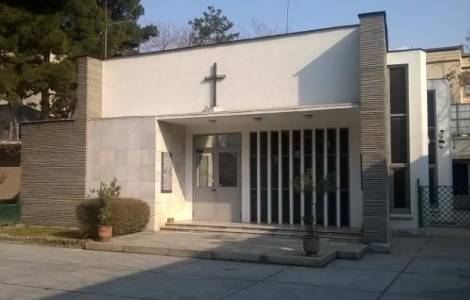
The origin story of the Chapel of Our Lady of Divine Providence in Kabul is quite unique, and it also says a lot about Afghan policy towards Christians even long before the Taliban became a thing. Back in 1921 when the modern Kingdom of Afghanistan was founded, Italy was the first country to give it diplomatic recognition. As an expression of gratitude, the Afghan ruler allowed the Italians to build a Catholic chapel in the grounds of their embassy. (The Holy See itself had and has no Apostolic Nunciature, i. e. embassy, in Afghanistan - the nearest one is in Islamabad, the capital of neighbouring Pakistan.) The chapel was completed in 1960 as a fully functional little church and dedicated to Mary, the holy mother of Christ ("Our Lady" in Catholicism always means Mary.). The location of the church within the Italian embassy grounds meant that it was protected by the rules of extraterritoriality, i. e. what happened in there wasn't subject to Afghan law. But it also meant that access to the chapel for any other people than the staff of the Mission itself, members of Christian religious orders, embassy (consular) staff and foreign military personnel was severely limited. It was never meant to be a parish church for Afghan nationals. Its was established on the condition that it was only supposed to provide spiritual care and support to people who were already of the Catholic faith, not for the purpose of evangelisation. And no Afghan government has since given permission to redefine that purpose. Accordingly, in a publication from 2017, the then head of the Mission duly referred to his parishioners as "not native Afghan Christians, just alien Christians temporarily living in Afghanistan". In that sense, the word "Mission" was rather misleading from the start in this case.
During the years of the Afghan Islamic Republic (2004-2021), parts of the city of Kabul also enjoyed special protection by the ISAF and local Afghan military forces. This so-called Green Zone included the Presidential Palace, the ISAF HQ, and many foreign embassies, including the Italian one and its chapel. Access to the Green Zone itself was tightly controlled by checkpoints and patrols, too, in order to reduce the danger of criminal activity and terrorist attacks against the institutions within the zone. This meant relative safety for the resident members of the Mission, but also made it doubly difficult for people based outside the Green Zone to attend church services or events at the chapel.
For the members of the Mission, it was a privileged life both in terms of immediate physical safety and in terms of their standard of living (access to food, clean water, healthcare, internet etc.) - maybe not so much compared to what especially the Italian priests had been used to back at home, but certainly compared to the local population. The place must have felt rather like a gilded cage at times.
"Gilded" is relative, though. This is the outside of the chapel:
And this is a view of the inside:
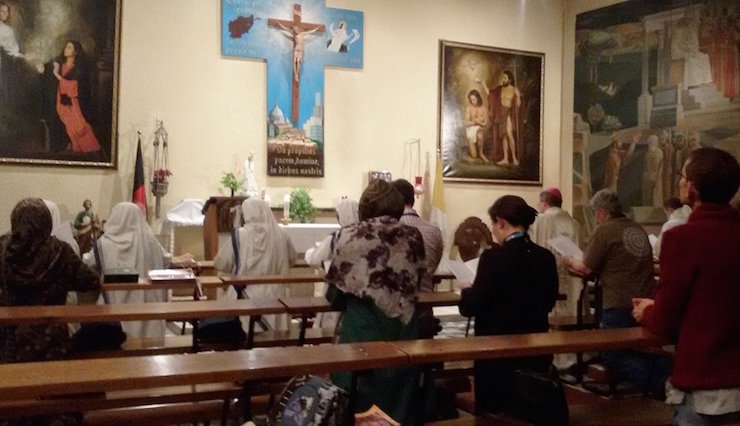
Note the Missionaries of Charity in their blue-bordered white saris in the first row. The priest is in the front row to the right. I'm assuming this is Monsignor Giovanni Scalese, who replaced Father Moretti as head of the mission in 2014. Monsignori are entitled to wearing a purple zucchetto, as Conclave fans will know.
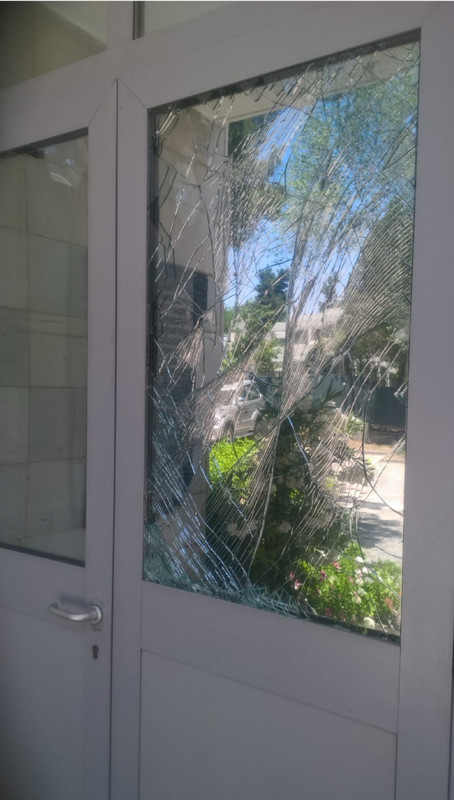
At this time, Afghanistan enjoyed a kind of uneasy partial peace. ISAF forces, together with the new Afghan National Army and local warlords such as the Northern Alliance, were still involved in fighting with the Taliban, the Central Asian branch of the Islamic State (IS) movement (called the Islamic State – Khorasan Province, ISKP or ISIS–K) and other Muslim extremists. There was no regular fighting in Kabul itself, but there was an omnipresent danger of car bombs, of suicide bombings and - especially on the roads outside Kabul - of ambushes with IEDs and kidnappings for ransom or to exert political pressure, often targeting foreign NGO staff. In May 2017, the German embassy (which was located close to that of Italy) was attacked by a bombing that broke the glass in the door of the chapel but luckily (or as a result of the eponymous Divine Providence, who knows) injured nobody.
The Catholic Mission was quite active at that time and - because it only served expats - didn't have to operate in secret. Traces of their activities can be found on the internet, such as a regular newsletter, fundraising events etc. However, there is a mention in one of the newsletters that they had meant to set up a publicly accessible website with their schedule of services and events as well, but were advised against so much publicity for security reasons.
I'm not sure what the working language of the mission would have been. The newsletter was in English, but the close link with the Italian embassy and the nationality of the priests suggests that Italian would have been spoken there a lot, too.
At its peak in the early 2010s, up to 100 people would attend Sunday Mass. The schedule of the Holy Week and Easter 2017 services, for example, is exactly as comprehensive as you'd expect from any Catholic parish in the world. During the Covid pandemic, however, the chapel closed to the public from March to October 2020, and due to the fear of infection and to travel restrictions, attendance was never very strong again in its final year of operation.
This is Monsignor Scalese saying goodbye to the Little Sisters of Jesus in 2017, after more than 60 years of service in the country:
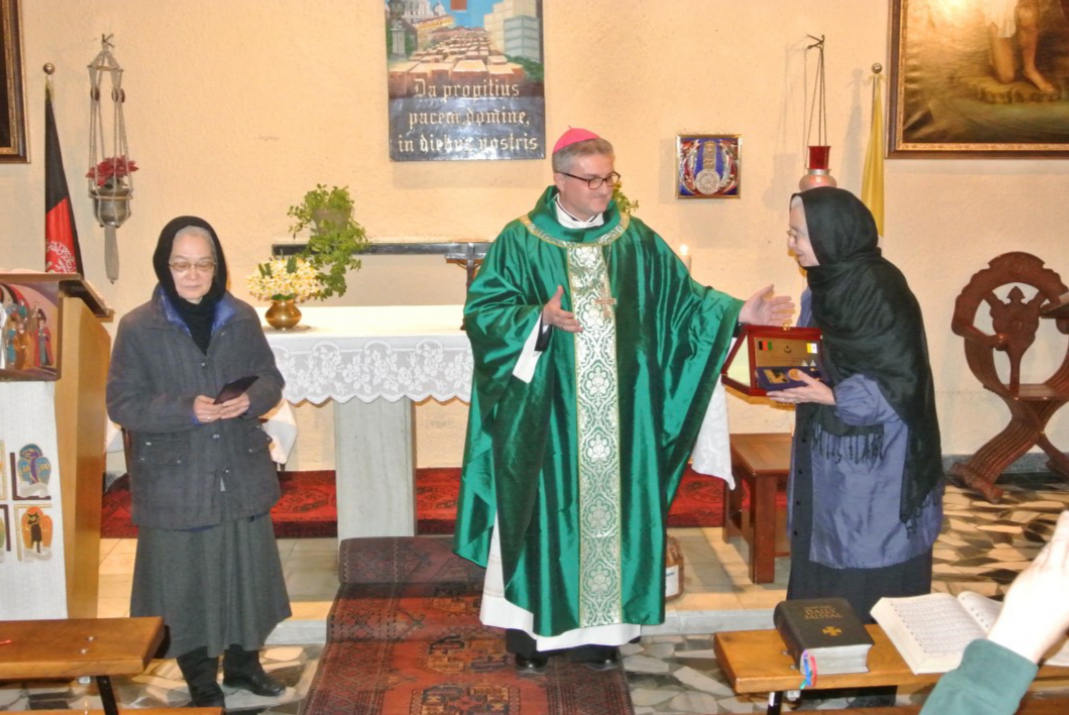
Note the prayer on the painting above the altar, which says Da propitius pacem, domine, in diebus nostris ("Give us peace in our days by your grace, Lord" or "Give gracious peace in our days, Lord" - I'm not sure the latin grammar is actually correct, but it's the sentiment that counts, right.)
And here's an undated photo of a service or ceremony outside the chapel presided over by Monsignor Scalese: 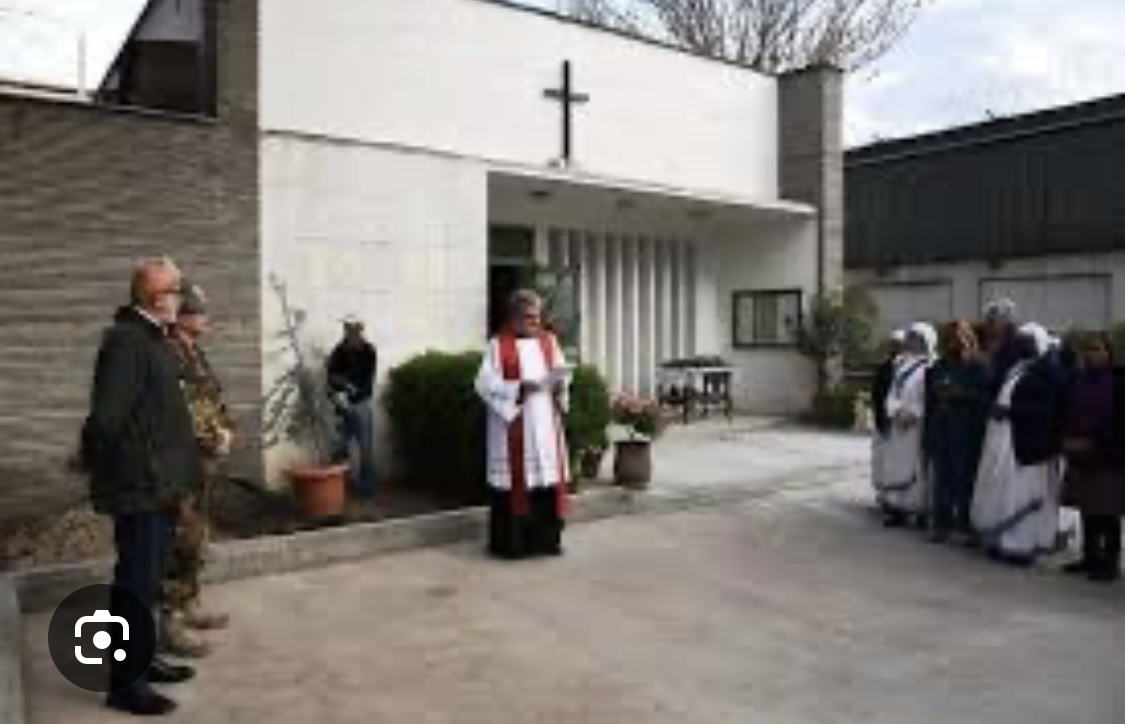
Please excuse the bad quality, but note the nuns on the right and the military person on the left - a very typical congregation at the time.
It is worth noting that the Mission was never very lavishly funded. As you can see from the images, its priest had proper vestments to wear and there were hymn books and all that. But the newsletter also contains several particular acknowledgments of donations by private individuals or from Western church groups and institutions of items that would normally be considered the bare minimum in any Catholic church. These included Lectionaries for Mass for weekdays (before 2017, they apparently only had the ones for Sundays), a Paschal Candle for 2017, and linen altar cloths handmade by the mother of an Italian Lieutenant-Colonel who seems to have been a faithful parishioner while deployed to Afghanistan in 2017. Ugly ducklings, remember.
Are you a little disappointed now just how "civilised" life at the Mission used to be during the ISAF years? I admit that my headcanon had looked rather different before I discovered all this. No, the head of the Mission wouldn't have had to sleep on the floor, or wouldn't have had to do without heating and running water. Crucially, he wouldn't have had to celebrate Mass only in secret, or live under an assumed identity and in constant fear of exposure. Yet. I promise, the hardcore stuff is coming. Times have changed a lot since then.
The Chapel of Our Lady of Divine Providence was the only consecrated Christian church in Afghanistan, but its priests were not the only Christian ministers, and the chapel was not the only place where Christian church services took place during the ISAF period. In addition to the Missio Sui Iuris, the US and other armed forces stationed in the country had military chaplains of their own who were imbedded in their units and who would conduct regular services at their respective military bases. At the height of US military presence in the country, there were six Catholic priests among the US chaplains alone.
The political and military situation in Afghanistan deteriorated after the ISAF mission was officially concluded in 2014 and replaced with Operation Resolute Support (RSM). This meant that a lot of Western military personnel left the country, and responsibility for the defence and security of the country was handed over to the Afghan National Army. Some thousands of Western troops remained, but mostly to train and advise the local forces, no longer with a fighting mandate (except for self-defence). Afghan national institutions, however, didn't prove strong enough to maintain peace and security on their own. The Taliban were soon on the rise again. Concurrently, the first Trump administration in the US (2017 - 2021) decided to end US/NATO involvement in Afghanistan as soon as possible (in the opinion that it had been a big mistake in the first place), and the formerly 'Resolute' Support became half-hearted at best. In February 2020 the US struck a deal with the Taliban (the Doha Agreement), who were by then back in control of parts of the country outside of Kabul, that there would be no mutual attacks until the Americans had officially left the country, which was supposed to have happened by the end of August 2021. The new Biden administration in the US (in power since January 2021) didn't change this policy, and step by step the Americans and their remaining allies withdrew.
By April 2021, the Taliban had got very impatient. They launched massive attacks against the Afghan National Army, and city by city and province by province they took back control of the whole country, meeting little resistance from the ill-equipped and often corrupt Afghan national forces. By early August 2021 already, Kabul itself and a narrow corridor leading from Kabul via Jalalabad and the Khyber Pass to Peshawar in Pakistan were the only parts of the country not yet under Taliban control.
The Americans and their remaining Western allies had made a historic miscalculation. Their intelligence services hadn't predict correctly just how quickly the Taliban would advance and how little resistance they would meet from the official Afghan government forces. As a result, their own retreat was ill-prepared and in the end became a total shambles. The US and their allies hastily started airlifting expats as well as vulnerable Afghans (such as employees of the Western powers and their families) out of the country. Kabul International Airport became an impromptu refugee camp for people hoping to get on one of the flights. NGOs shut down their offices overnight. Embassies closed and got ready to evacuate, and together with the Italian embassy, so did the Catholic Mission.
By Sunday, 15 August 2021, the Taliban were in Kabul. The remnants of the Afghan National Army quietly crumbled into dust. The democratically elected Afghan president, Ashraf Ghani, fled into exile in the United Arab Emirates.
During the two weeks after the Fall of Kabul, in the second half of August 2021, the world was watching in horror as people from all over the country kept trying to crowd into the airport - the only island of safety not yet controlled by the Taliban - and get a place on one of the planes out. Parents tried to hand their children over to the soldiers just to make sure they got away to safety, even at the price of being separated from them forever. People endured appalling living conditions in the airport grounds while many waited for days to be cleared for a place on a flight. People died, trampled or crushed while queuing at the heavily guarded gates. People died, trying to literally cling to the landing gear of the planes that were taking off without them. Over 170 people died in a horrific ISKP suicide bombing attack at an airport gate on 26 August alone. The evacuation operation was one of the largest airlifts in human history. Between 14 and 25 August, the US alone evacuated about 82,300 people. In total, over 122,000 people were airlifted abroad during this period, often crammed into military transport aircraft like the American C17 like sardines – the record was 823 passengers on a plane designed for no more than 300. On the busiest day, flights took off from the single runway every 34 minutes.
I don't think I can overstate just how bad those weeks in August 2021 were. How much fear there was. How quickly it became outright panic. How abandoned people must have felt by the Afghan national government and its Western allies when even the remaining military forces began telling people that they couldn't do much to protect them any more. There are plenty of articles, documentaries and podcasts with heartbreaking eyewitness accounts out there, if you want to go on a deep dive. Be sure to bring tissues.
This was the situation that the remaining members of the Catholic Mission were caught up in, too. They only left when the Taliban had already seized control of the entire city with the exception of the airport. According to Monsignor Scalese, "outside the gates of our embassy, there were Taliban who, if they wanted to harm us, they could have. But absolutely nothing happened." (There is no mention of any of the other Barnabite priests in this interview, so I'm assuming that they had already left earlier, possibly already in conjunction with the Covid pandemic.) Scalese and the five remaining nuns tried but failed to get into the airport several times. More than a week after the fall of Kabul, they finally succeeded and, together with the 14 children with disabilities who had lived at the orphanage at the time, they got on a military aircraft to Kuwait and from there to Rome, where they arrived on 25 August. The nuns who ran the Pro Bambini di Kabul school were evacuated as well. Their pupils, who were not orphans but day pupils who lived with their own families, had to remain behind. The fate of two Jesuit priests from India who had also still been present in the country on 15 August is unknown to the English-speaking internet.
This, in Real Life, marked the end of the presence of the Catholic Church in Afghanistan.
Most sources agree that the Taliban deserve credit for letting the expats and many thousands of their Afghan allies and employees clear out without bloodshed, but there was no knowing at the time that they would. So it would have been an incredibly tense and dangerous situation. Monsignor Scalese recalls that "We all waited for a more negotiated conclusion, a transitional or national unity government. But in a few days, everything fell apart: government, army, police forces. The Taliban didn't even fight to take power: they simply took control. This had a good side, in part, because it avoided a bloodbath."
No bloodbath then, but after that, things got so, so much worse. I will explore the situation of Christians in Afghanistan after the 2021 Taliban takeover in the next section.
III. Christians in Afghanistan since the 2021 Taliban Takeover
1. General Political Overview
CARDINAL BELLINI: How could we possibly ensure his safety?
Short answer: You couldn't. Nobody could, not any more.
The Americans honoured the 2020 Doha Agreement to the letter. They had promised to leave Afghanistan to its fate from 31 August 2021 onwards and they did exactly that. The last American plane, carrying the final remaining contingent of US and NATO soldiers as well as the last Western diplomats away from Kabul International Airport, took off on 30 August 2021 at 11:59 PM, exactly as agreed.
Any expat who was still on the ground in Afghanistan by September 2021 was on their own, and knew it.
Since 15 August 2021, the Taliban have been the de facto rulers of the country, now again called the Islamic Emirate of Afghanistan. The country is no longer technically at war, but there continues to be violence, mostly from rivalling Islamist groups like ISKP. Many Afghans also live in abject poverty, because the national economy has been all but destroyed by the many years of war, and there is little to no humanitarian aid from foreign and international NGOs, who mostly pulled out in 2021.
There are also constant human rights violations. The Taliban's particular brand of Islam is a very repressive one. They reintroduced Sharia law, making their regime essentially a theocracy, in which religion and religious rules take priority over anything else, especially over an individual's rights and needs, and in which those in power claim legitimisation by divine sanction, rather than by a democratic process.
Women are paying the highest price under the new regime. Afghanistan under Taliban rule consistently ranks as the worst or one of the worst countries on earth to be a woman. Women are subject to multiple repressive and degrading laws and rules. They are banned from seeking employment outside their home, they cannot go out unless accompanied by a close male relative, they cannot be heard to speak or show any part of their face or body outside the home, and they are banned from all secondary and tertiary education, with school ending after Year 6 for girls if they attend at all. The Islamic law of Afghanistan also consistently puts women in an inferior position to men in matters of family law, divorce, custody of children and inheritance. There is no protection from gender-based violence and domestic violence. These are just some examples. Imagine the situation as bad as you possibly can, and then add some.
International relations are very patchy. As of June 2024, no other country had recognized the Taliban government as the legitimate authorities of Afghanistan. Russia has done so since, but no Western nation maintains an embassy in Kabul any more. So there is no diplomatic representation of any of the Western nation within Afghanistan, and no consular assistance or extraterritorial safe spaces if the local authorities decide to go after any of their nationals. The Taliban have let some NGOs back in since 2023, but only to a very limited degree. There is no security infrastructure in place for their staff, except for some few private security contractors.
While life is not easy for anyone in Afghanistan today, the situation of Christians since the Taliban victory on 15 August 2021 has been nothing short of catastrophic.
2. Legal and social situation of Christians in Afghanistan since 2021
CARDINAL LAWRENCE: Presumably that's why the Holy Father wanted it kept secret.
Yep. There is zero religious freedom for Christians in Afghanistan these days. Zero. Any Christian life and activities have had to go completely underground.
It's important to remember that there are, broadly speaking, two types of Christians in Afghanistan: Christian expats are one group (mostly employees of NGOs now; before the 2021 takeover this group would also have included the foreign clerics and members of religious orders, army personnel from the US and their allies, and foreign consular staff). Afghan converts from Islam are the other group. I assume that it's become clear already that Afghanistan has never been big on allowing religious freedom for its own nationals. The Catholic Mission was always expressly limited to only serving foreign residents, and even that was considered a special privilege. But under the Taliban, the situation has become very much worse for both groups.
The following facts are largely taken from the 2025 World Watch Report on Christians in Afghanistan by the Christian charity Open Doors International. The reporting period was 1 October 2023 - 30 September 2024. You can also find information on Christians in Afghanistan on the Shai Fund's website, a Christian charity from the US, here and here.
a) Numbers and Origins
CARDINAL BELLINI: How many Catholics are there in Afghanistan?
Good question. We honestly don't know. There's no reliable data.
While the Afghan Constitution of 2004 theoretically guaranteed that adherents of other religions than Islam were free to exercise their faith, Article 3 of the Constitution also stated that no law should contravene the tenets and provisions of Islam. So even before the Taliban takeover, Afghanistan was considered by its government and by the majority of its population to be an inherently Islamic country. Afghan nationality and Islamic faith were so intricately linked both in law and in most people's minds that nobody ever held a census to determine if and how many people practised another religion than Islam. Since the takeover, proclaiming yourself openly to be a Christian has just become another way to die.
Different types of converts exist in Afghanistan, all of whom come from a Muslim background. There are those who left as asylum seekers for Western countries and found the Christian faith there and then returned to tell others. There are those who are descendants of the first converts to Christianity after contact with Western nations in the 20th century. And there are Christians who converted recently, after being exposed to Christian teaching and evangelism through radio, internet, satellite TV or word of mouth. Some Christian charities like to claim that this third group is growing, claiming that people are becoming disillusioned and frustrated with Islam as the economic and political situation continues to go downhill under Taliban rule, and are looking for alternatives. However, there's nothing but occasional anecdotal evidence to back that up, so this supposed trend could just be wishful thinking.
As for actual numbers, all we have are estimates, and they vary widely, from up to ten thousand Christians (of all denominations, including but not limited to Catholics) to only a few hundred. There's no way to make sure.
b) Legal and Social Consequences for the Individual
The legal situation of Christian converts in Afghanistan is as simple as it is terrifying:
The Islamic Emirate of Afghanistan does not allow any Afghan citizens to become Christians. Conversion is seen as apostasy and brings shame on the family and the Islamic community. Theoretically, the Sharia law punishment for apostasy is death. There has been no report of any official judicial death sentence imposed on any Afghan national for converting to Christianity since 2021. But understandably, nobody is eager to put the theory to the test and reveal their Christian faith just to see how far the Taliban's tolerance extends.
Converts hide their new-won faith as far as possible from their family, friends, neighbours and the wider community. All Afghan citizens are facing strict limitations in everyday life inspired by Islamic tenets, and women even more so. Christian converts do not have any space to deviate from the behaviour expected from everyone. Depending on the family, they may even have to fear for their lives. Even the suspicion of being a Christian can bring severe persecution.
Any promises made to international bodies by the Taliban about implementing international human rights standards have evaporated. There are reports of extrajudicial killings of Christian converts, and of women converts being forcibly married to Muslims and forced to recant their beliefs. Christians cannot display any religious images or symbols without fear of violence or discrimination from local political and Islamic religious leaders. Children of Christian converts are forced to adhere to Islamic religious precepts and receive Islamic teaching, since the Taliban have overhauled the entire education system to implement a heavy emphasis on Islamic studies in any curriculum and at any level. In rural areas, Islamic religious schools (madrassa) are often the only kind of formal education available at all.
In addition to the nonexisting official legal protections for Christians under the Taliban, there is massive social pressure. Christianity is seen by many individuals, families and local authority figures as a rejection of Afghan culture and society which needs to be stopped. Since society is tightly knit, social control is high and keeping things private is difficult. As a result, converts run a high risk of being discovered, which not only means immense psychological and emotional pressure, but can also lead to painful alienation from the rest of the family and their usual social circles such as neighbours and colleagues. The modern Western concept of a nation is rather alien to the Afghan way of thinking. Afghanistan is diverse in terms of ethnicities and language. In many parts of Afghan society, the family comes first, followed by the clan and then the tribe – and all of these are much more important than the country as a whole. But as a result, if someone dares to turn from their tribe to embrace something new and maybe even foreign, this results in high pressure to make that person return to traditional norms. If the individual persists, they will be looked upon as a traitor to the community, and ostracised for that reason, as much as for offending God by committing blasphemy. There are reports of extrajudicial "honour killings" of Christian converts by their own family or clan.
The Taliban have been very adept at incorporating this kind of thinking into the way they rule the country, often teaming up with local ethnic and religious leaders to monitor people's strict adherence to Islamic law and customs. For example, men will be asked to account for themselves if they don't attend the mosque regularly, if they don't observe the prescribed Islamic prayer times, or if they don't grow a beard as a traditional expression of Islamic piety – all of which Christian converts would try to avoid.
Anyone found to be practising Christianity may be imprisoned and interrogated, with the aim of finding and eradicating underground networks. And since this is the Taliban, you can all imagine what those interrogations look like.
c) Consequences for the Family Unit
Due to these restrictions, it's extremely difficult for Christians in Afghanistan to build any sense of community. This doesn't only affect them individually, but also the whole family as a unit.
Adult converts often hide their faith from their own younger children, which is extremely painful since most believers will of course want to raise and instruct their children in the same faith. Additionally, converts will often not want to send their children to an Islamic madrassa, which in rural areas often leaves them without any schooling at all, since there are no alternative institutions. Older children who are converts themselves or who are aware of their parents' conversion will often be left confused and conflicted and unable to reconcile what they hear at home with the anti-Christian indoctrination that they experience even at regular non-madrassa schools.
There are reports of children of converts being taken from their parents and forcibly adopted by Muslim families.
Youth work, a cornerstone of many Christian communities, is impossible.
A woman who is found out to have converted to Christianity by her Muslim husband will often be divorced and thus left without legal and physical protection, as well as robbed of her livelihood. She will also often experience terrible abuse. There are reports of cases where the husband killed his convert wife and wasn't prosecuted because the killing was deemed justified.
In cases when the husband converts, the Muslim wife's family will often put pressure on her to secure a divorce even if she personally doesn't want it.
There are reports of young, unmarried women converts being forcibly married by their families to Muslim men in order to "bring them back under control."
There are reports of Christian converts being sent to a mental hospitals, since their families believe that no sane person would ever leave Islam.
As most Afghan Christians will keep their conversion secret, they will be buried according to Islamic rites when they die, which comes with its own spiritual pain for any friends or family members who knew the truth.
d) Religious Acts, Symbols and Materials
CARDINAL LAWRENCE: Our new brother's ministry is an extremely dangerous one.
That is probably stating the obvious by this point.
Under the Taliban, it's not possible to openly or officially conduct Christian religious ceremonies such as church services or Mass, weddings, baptisms or burials anywhere in Afghanistan. Baptism of a former Muslim constitutes apostasy, which in Sharia law is punishable by death. If an expat were found to conduct or attend any of these ceremonies, they would be arrested and deported, since proselytising for any other faith than Sunni Islam is forbidden. If the 'culprit' was an Afghan national, they would face violence, imprisonment and subsequent social or even physical death. For both kinds of persons, there would also be the danger of on-the-spot extrajudicial mob violence leading to serious injury or death, which the Taliban are known to tolerate if it serves their own ends.
The same applies to other Christian practices that manifest in words and/or gestures, such as publicly making the sign of the cross, reciting Christian prayers such as the Our Father prayer or the Christian Creed, or singing Christian hymns.
Consequently, the Taliban do not tolerate official representatives of other faiths than Islam in their country. No Christian priest or pastor would be allowed to enter the country or to remain there if they were known to be a priest or pastor. The same goes for members of religious orders such as nuns and monks, of whom there are none currently known to reside in Afghanistan, either. Christians, even lay persons, cannot set up charitable organisations, train their own leaders or apply for permits to build a church. (The Catholic chapel of Our Lady of Divine Providence in the grounds of the former Italian embassy in Kabul is obviously no longer in operation. For all we know, it's still standing, but it will be empty, gathering dust.)
It's also not possible to publicly display or use Christian symbols or materials, such as crosses, crucifixes, the Bible, hymn books or books of Christian religious instruction, missals, rosaries, images of Christ or of saints, or the implements used to celebrate the Eucharist such as sacramental bread and sacramental wine and the vessels that contain them. And while it would of course be technically possible to celebrate the Eucharist in secret with inconspicuous homemade bread, too, wine is a different matter because alcohol as such is strictly forbidden in Taliban-style Islam, and you just can't get it legally.
Even private ownership of such items by an Afghan national can lead to severe persecution, as it will be seen as proof of apostasy. It might be tolerated in an expat, but strictly for private devotions only, not for missionary work. If the latter was suspected, the items would be confiscated and destroyed. A repeat 'offender' would be arrested and deported. What NGO workers there currently are in the country are legally and/or contractually forbidden to interact with locals outside of the disclosed nature of their work (such as healthcare or the distribution of food). This especially applies to travel within the country, which will be monitored and can be restricted on suspicion of missionary activity. Even just to make contact with local Christians would thus be very difficult for a Christian expat.
Given these restrictions, online content plays a big role in how Christians access Christian material in Afghanistan and how they interact with fellow believers. However, all forms of media are controlled by the Taliban, except shortwave radio and social media. Those who have smartphones and access to the internet will often delete any trace of such materials, messages and browser history after each use, as authorities will arbitrarily check phones for subversive material. Even just showing interest in any religion other than Islam and looking up other teachings and traditions online means running the risk of being suspected of apostasy, even if you were just curious.
As a result, converts in Afghanistan have great difficulty meeting each other in person. Any meeting of people not connected by an obvious link such as family relations, work or Islamic events and traditions will be viewed suspiciously by local authorities. The 20025 Open Doors Charity's Report on Christians in Afghanistan quotes an expert as saying, "Churches are underground and [services are] held in secret; people are not able to share their faith openly, sing loudly or meet for communion. Therefore, 'church services' tend to look like a group of people meeting over a meal".
They also need to exercise the utmost care when listening to Christian radio or listening to/watching Christian programs on the internet, especially as there is very little privacy in Afghan culture. Unless the whole family unit has converted, even praying and Bible reading are only possible when converts are sure they are alone.
Christian expats, while enjoying greater tolerance concerning their private devotions, will be kicked out of the country quicker than it takes to say a Hail Mary if they're even so much as suspected of encouraging locals to engage with the Christian faith.
That, guys, is the actual Real Life backdrop for a 2024 movie featuring an Archbishop of Kabul. Frightening? You bet. But also somehow more Vincent Benítez's style than life at the Mission until 2021? You bet, too.
In the following section, I'll try and square Real Life with movie canon as far as possible (and also be honest about it when it doesn't work).
IV. Application to the "Conclave" (2024) Universe - Possibilities, Probabilities and some Headcanon
CARDINAL BELLINI: A cardinal in Afghanistan? It's absurd.
The Archbishop is absurd already, never mind the Cardinal. I assume that it has become clear from Part II that any Archbishop of Kabul pre-2021 would have existed only in a heavily armed fortress, and from Part III that post-2021, he would have become a martyr within a week if he hadn't gone into exile.
But then again, it would have been technically easier to make Vincent a cardinal than to make him archbishop in the first place. That's because in Real Life, dioceses and their bishops - unlike cardinals - can't be created in pectore, i. e. in secret. In pectore Cardinals, sure, fine. Plenty of Real Life precedents. The only aspect of that concept that the movie played fast and loose with was the idea that in pectore cardinals are allowed to vote in a Conclave, which they are not in Real Life. In pectore b ishops? Not so much. Dioceses are required to be set up by a legal act of canon law, and those acts are public. A priest becomes a bishop through an act called consecration, which has to be performed by another bishop, usually in a public Mass. It can't be done by a letter or online, both men have to be physically present in the same place. I've looked far and wide but failed to find a documented Real Life case of a secret diocese with a secretly appointed bishop. But then, maybe there is one, maybe in North Korea, and we obviously wouldn’t know about that. The concept requires mental gymnastics, but I must admit that I find those gymnastics quite appealing. The Pope is obviously a bishop himself, i. e. authorised to personally consecrate new bishops. He has a private chapel where he could conduct their inaugural Mass without a lot of people knowing. And maybe there always was an Archdiocese of Kabul in the movie universe, and it was just vacant for a long time before Vincent Benítez arrived to revive it. That would make him both a plausible fictional counterpart of Monsignor Scalese of the Kabul Mission, and a plausible archbishop at the same time. The Afghan Republic phase (2002 - 2021) was a time of comparative optimism regarding the future of Afghanistan. If any Pope would have come up with the idea of creating or reviving an archdiocese in the country, it would have been then. If done publicly, it would still have been a huge political provocation and might have endangered the generally constructive relationship between the Afghan government and its Western allies as a whole. In secret, however…
No matter how it came into existence - if we picture the Catholic Mission during the Afghan Republic (2002 – 2021) as an actual archdiocese rather than just a Mission Sui Iuris, as the movie universe requires us to do, day-to-day work in Kabul would have been very, very different from your average archiepiscopate. These guys usually have a whole chapter of cathedral canons to help them lead the diocese, a large number of support staff, and a palace to reside in. All that would have been impossible in Afghanistan. So this would basically be an archbishop without all the usual trappings of an archiepiscopate, and that poor, modest chapel of Our Lady of Divine Providence would have been the smallest and shabbiest cathedral on the planet. And that would be very much in character for Vincent Benítez, if you ask me.
And then we get to the watershed moment of the Fall of Kabul and the Taliban takeover in August 2021. And this is of course also the point where movie canon departs irreconcilably from Real Life. Because Monsignor Scalese left, and I want to make it perfectly clear that it was the sensible thing to do and I wouldn't blame him for a moment and he and the sisters literally saved the lives of 14 incredibly vulnerable children that way. But Vincent Benítez stayed. And he would have had to ask himself the very tough question, what for?
He had been an archbishop of expats, but they had all left. He had been stuck in the Green Zone, and he'd had to rely on armed guards and foreign soldiers to keep himself and his parishioners safe. All those were gone, too. He was an archbishop without a flock, and thus without a purpose.
I can't help thinking, however, that his previous work can't have been entirely congenial to him as a person. My guess is that he would have got rather frustrated at times, reduced to living inside a cage and providing spiritual care only to privileged homesick Westerners, while outside the Green Zone, Afghan people were already being harassed, ostracised, beaten and even killed for their Christian faith, especially as the Taliban advanced and brought more and more parts of the country under their control. Given his previous ministries in the Congo and in Iraq, which are presented to us as being very hands-on, it must have been difficult for him to accept a posting with such an extremely limited scope, when there was a much more dire need for spiritual care and support right on the other side of the walls and fences surrounding him.
Imagine, then, the Fall of Kabul and the Taliban seizing power almost as a liberation for Vincent, unlikely as it may sound.
Imagine Vincent on 15 August 2021, a Sunday, celebrating Mass openly for the last time. Imagine him waving goodbye to the sisters and the orphaned kids at the airport, and eventually watching the last American plane take off without him. Because he already felt that God was calling him to another type of work now.
Imagine him locking up his empty chapel and walking away, no more backup, no more safety net. But head still held high, heart still full of love, still determined to make a difference to the people who now need him more than ever. He'd always known they were out there, and for the first time, he was finally free to go and join his true flock. Wouldn't he have shaken the dust of his former life off his feet, laced up his black sneakers and gone to find them?
Imagine Vincent becoming the true Archbishop of Kabul only when the job had officially ceased to exist.
This, to me, is the Vincent who two years later, while "meeting with a group of friends over a meal", gets handed the letter from Rome, smuggled into the country by a complicated network of underground couriers, that makes him a cardinal. This, to me, is the Vincent who agonised for days over whether to stay or go when the Holy Father died a year later, because he knew he could never come back, or that he wouldn't survive for long if he did. The Vincent who only left because his parishioners begged him to be their voice in Rome, to tell the world that they existed and how much they suffered, and to make sure the new Pope would know and listen.
What do you mean, you thought you couldn't possibly love the guy more than you already did? Yeah, same.
P. S. I don't suppose he hangs out on AO3 so we will never find out, but I would very much like to know whether Monsignor Scalese has seen the Conclave movie. And whether Vincent's first appearance made him go "damn, that's me!?". I just hope that he didn't leave the cinema thinking "damn, that should have been me". Because that's what movies are for, aren't they. To be larger than life. There's no shame in being real.